Honoring Tradition While Building What’s Next at Xavier University
July 14, 2026
July 14, 2026
Balancing fresh, modern solutions while keeping traditional and historic architectural elements intact is just one of the many ways we support our customer’ goals.
That approach has been essential at Xavier University, where a historic neo-Gothic aesthetic helps define the campus’ setting. Each step toward new campus infrastructure requires a careful balance, respecting the university’s architectural legacy while allowing its new facilities to meet future needs.
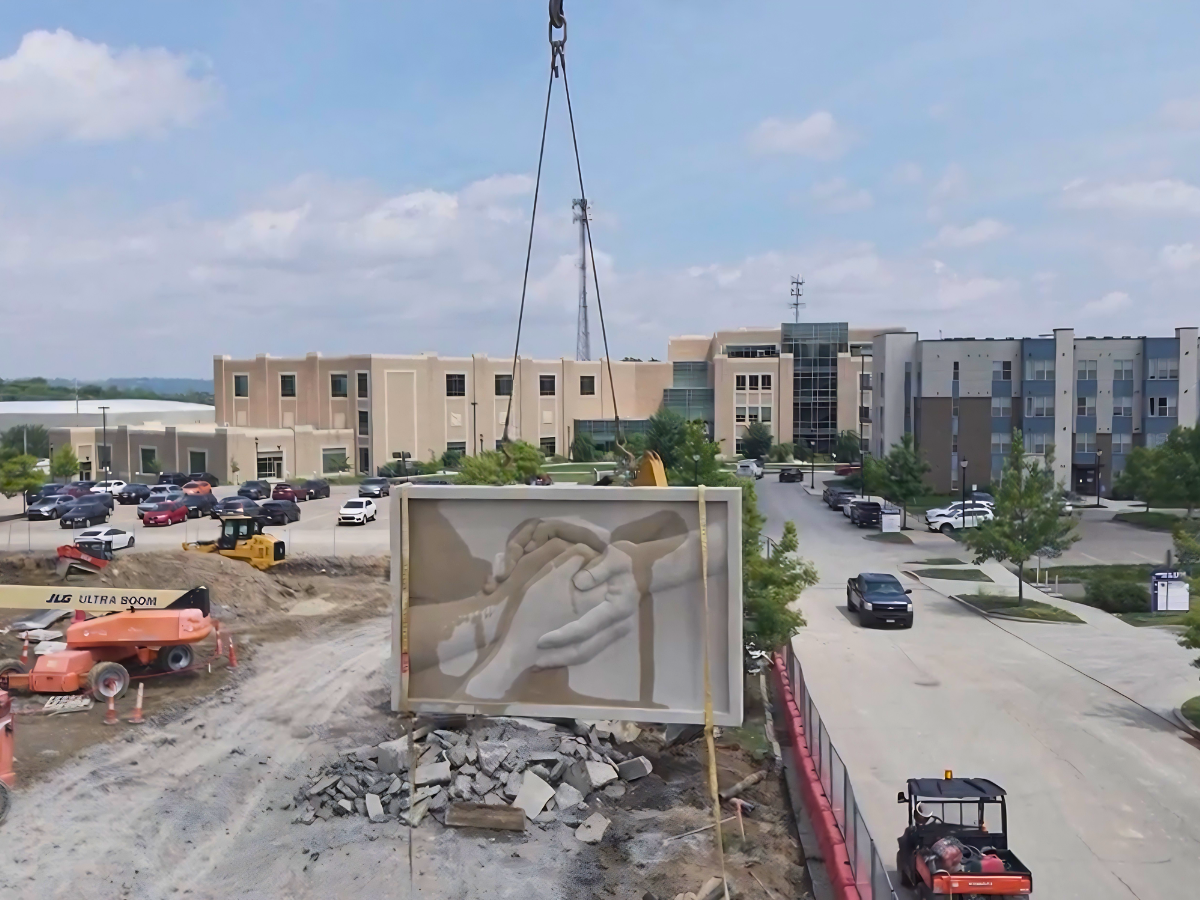
One example of this is the use of architectural medallions—custom cast elements that feature symbolic imagery—are a defining detail across Xavier University’s campus and play a key role in preserving its historic identity.
“Medallions are an important part of Xavier,” Project Solutions Manager Matt Mintus said. “The new College of Osteopathic Medicine, for example, features the Helping Hands and the Rod of Asclepius, the god of healing in mythology. Medallions keep coming up across Xavier’s campus because they’ve really become part of the university’s identity.”
Messer first navigated this challenge in 2019, delivering a solution that upheld the integrity of the Xavier University Health United Building (HUB) that was coordinated and installed by Ollier Masonry.
Nearly seven years later, we’re proud to build on that experience—bringing the same level of care and attention to detail to the Xavier College of Osteopathic Medicine project.
The process begins with detailed 2D renderings that outline what each medallion will look like long before the concrete is poured. Throughout that phase, we worked closely with partners like Reading Rock, a company specializing in the manufacturing and supply of high‑quality hardscape, masonry and hearth products for residential and commercial projects.
“The architect team (SLAM, MSA) finalized two concept photos with Xavier and the artist modeled those in 3D. After a couple of rounds of small changes, the files were sent for conversion. This would allow the digital files to be useable with Reading Rock's machinery.”
Once the designs moved into the 3D phase, Reading Rock created scaled‑down versions of the medallions to ensure the details met Xavier’s expectations before full production began.
“We wanted to do some test trials, where we could take a small sample of the digital concept the artist had created and run it through the conversion process,” Mintus said. “That meant sending it to the company handling the conversion and then getting it to Reading Rock ahead of full production.”
Those trials helped validate the process and ensured everything was aligned before the final pours took place.
“That way, they could verify they were able to take the model, load it into their machine and produce a smaller test piece,” Mintus said. “Once we validated that the process worked, we knew we could move forward and start creating the pieces.”
The steps that followed spanned another two and a half months, encompassing design, review and approvals, along with preparation and fabrication setup. Each phase required careful coordination across teams and partners.
“The goal is to give them a better product each time, a better service each time we do something for them, so they can really see the Messer difference,” Mintus said.
This project is just one example of how Messer’s Operations Technology Solutions team supports our customers and projects across our regions.
© Copyright Messer Construction Co. 2026
| Cookie | Duration | Description |
|---|---|---|
| client_ip | 1 year | The cookie is used in order to serve region-specific pages. |
| cookielawinfo-checkbox-advertisement | 1 year | The cookie is set by GDPR cookie consent to record the user consent for the cookies in the category "Advertisement". |
| cookielawinfo-checkbox-analytics | 11 months | This cookie is set by GDPR Cookie Consent plugin. The cookie is used to store the user consent for the cookies in the category "Analytics". |
| cookielawinfo-checkbox-functional | 11 months | The cookie is set by GDPR cookie consent to record the user consent for the cookies in the category "Functional". |
| cookielawinfo-checkbox-necessary | 11 months | This cookie is set by GDPR Cookie Consent plugin. The cookies is used to store the user consent for the cookies in the category "Necessary". |
| cookielawinfo-checkbox-others | 11 months | This cookie is set by GDPR Cookie Consent plugin. The cookie is used to store the user consent for the cookies in the category "Other. |
| cookielawinfo-checkbox-performance | 11 months | This cookie is set by GDPR Cookie Consent plugin. The cookie is used to store the user consent for the cookies in the category "Performance". |
| PHPSESSID | session | This cookie is native to PHP applications. The cookie is used to store and identify a users' unique session ID for the purpose of managing user session on the website. The cookie is a session cookies and is deleted when all the browser windows are closed. |
| viewed_cookie_policy | 11 months | The cookie is set by the GDPR Cookie Consent plugin and is used to store whether or not user has consented to the use of cookies. It does not store any personal data. |
| Cookie | Duration | Description |
|---|---|---|
| CONSENT | 16 years 5 months 23 days 10 hours 22 minutes | These cookies are set via embedded youtube-videos. They register anonymous statistical data on for example how many times the video is displayed and what settings are used for playback.No sensitive data is collected unless you log in to your google account, in that case your choices are linked with your account, for example if you click “like” on a video. |
| Cookie | Duration | Description |
|---|---|---|
| IDE | 1 year 24 days | Used by Google DoubleClick and stores information about how the user uses the website and any other advertisement before visiting the website. This is used to present users with ads that are relevant to them according to the user profile. |
| test_cookie | 15 minutes | This cookie is set by doubleclick.net. The purpose of the cookie is to determine if the user's browser supports cookies. |
| VISITOR_INFO1_LIVE | 5 months 27 days | This cookie is set by Youtube. Used to track the information of the embedded YouTube videos on a website. |
| YSC | session | This cookies is set by Youtube and is used to track the views of embedded videos. |
| Cookie | Duration | Description |
|---|---|---|
| yt-remote-connected-devices | never | No description available. |
| yt-remote-device-id | never | No description available. |